Use the largest social network, the phone, to reach those shut-ins the feel left out of Sunday worship by the technology gap created with live streaming.
Your church is already using Facebook Live or a church live stream to broadcast worship services online. But here is the uncomfortable truth: your stream will never reach the shut-ins and bedridden members who need it most. They do not use the internet. They cannot navigate apps. They will never join a Zoom call.
PhoneLive.io solves this instantly. It automatically calls your shut-ins and bedridden members when your service begins, delivering live worship audio through their existing phone — no internet, no smartphone, no menu, no access codes, and no learning curve required.
If your church already streams to Facebook Live, you are 90% of the way there.
Key Takeaways
- PhoneLive.io bridges the gap by automatically calling shut-in members via standard telephone when a service begins — no action required from the member.
- No extra volunteers needed: PhoneLive.io integrates directly via RTMP with your existing video streaming system, running automatically every week once configured.
- Any phone works — landline, flip phone, or basic cell phone. No internet, no app, no login required.
- Over 1,200 churches already use PhoneLive.io, delivering worship to approximately 20,000 people every week via a simple phone call.
5 Steps to Bring Your Church Live Stream to Every Shut-In and Bedridden Member
- Keep streaming as you already do — Continue using Facebook Live, YouTube, or any church live stream platform (Resi, Boxcast, StreamYard, vMix, OBS).
- Send a copy of your RTMP feed to PhoneLive.io — This is the same standard stream protocol you already use. No new equipment or training needed.
- Add your shut-ins’ phone numbers — Enter the phone numbers of bedridden, homebound, or elderly members who cannot access the internet.
- Go live — the phone rings automatically — When your service starts, PhoneLive.io calls each member. They simply answer the phone and listen live.
That is it. Four simple steps. No extra volunteers. No tech support calls from confused seniors. Just a ringing phone and a live connection to their church family.
Why Your Facebook Live Stream Leaves Shut-Ins and Bedridden Seniors Behind
Approximately 2 million adults aged 65 and older are completely or mostly homebound in the United States, according to research published in JAMA Internal Medicine. An additional 5.5 million seniors can only get out with significant difficulty or assistance, as reported by KFF Health News.
While Pew Research Center found that 90% of adults ages 65 and older are online, the oldest and most isolated — the very people who need church most — are in the remaining 10%. And among the homebound, digital technology use drops dramatically.
Facebook Live requires a Facebook account, a smartphone or computer, reliable internet, the ability to navigate an app, and the dexterity to tap, scroll, and unmute. For a bedridden 87-year-old with arthritis, poor eyesight, or dementia, these are insurmountable barriers.
Churches invest thousands in cameras, encoders, and streaming platforms to reach the world — but the shut-in member three miles away in a nursing home cannot participate. Learn how Jim Keat and The Riverside Church of New York City faced the challenges and innovations in online worship, and why connection, accessibility, and community building is important in a digital age.
What Do Shut-Ins and Bedridden Members Actually Need?
The answer is simpler than most churches realize. Here is the contrast between what Facebook Live demands and what shut-ins can actually handle:
What Facebook Live requires: Internet connection, smartphone or computer, Facebook account and login, app navigation and scrolling, troubleshooting buffering issues.
What shut-ins can do: Answer a ringing phone. Use a landline or basic cell phone. Recognize their pastor’s voice when they simply pick up the receiver. Listen clearly with no buffering.
The telephone is the one technology that every generation understands. It requires no training, no updates, no passwords, and no internet connection. If they can answer a phone, they can attend your worship service.
How PhoneLive.io Bridges the Gap Between Your Church Live Stream and the Telephone
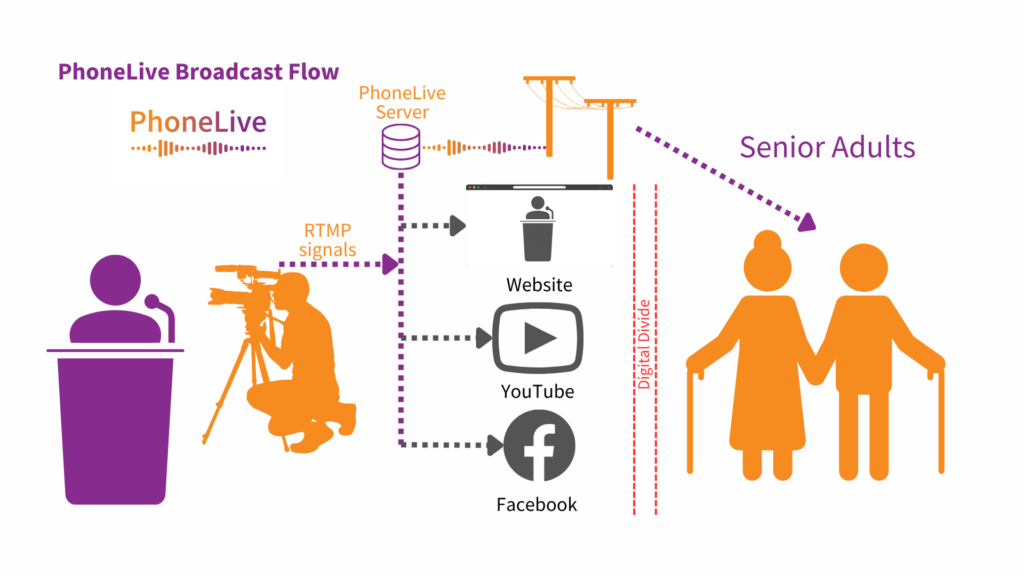
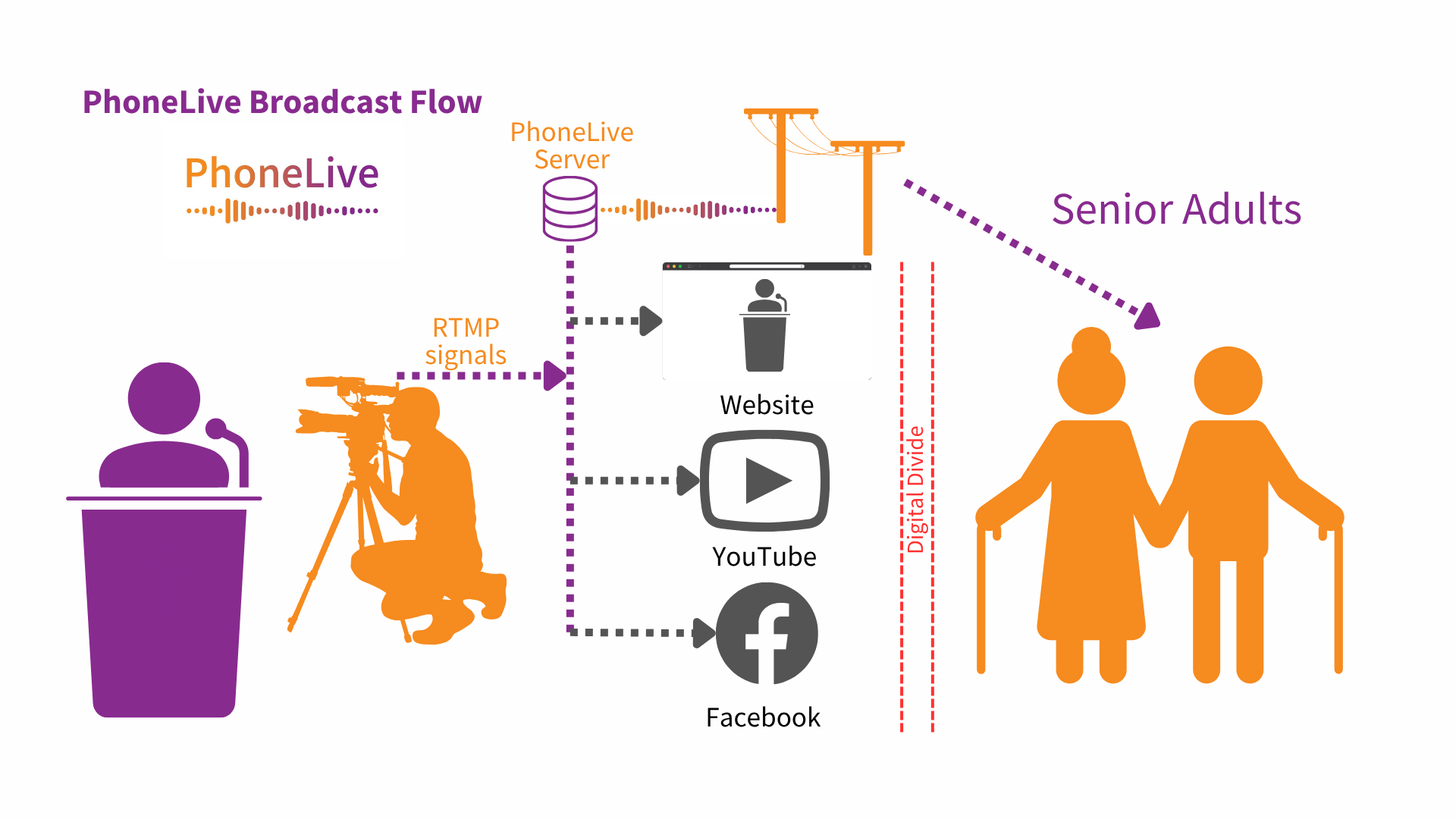
PhoneLive.io works alongside your existing Facebook Live or church live stream — not instead of it. The technical flow is simple: your camera sends a standard RTMP stream to your streaming platform and simultaneously to PhoneLive.io. The PhoneLive server converts that stream into crystal-clear phone audio and delivers it to your members’ telephones.
Here is what this means for your small church:
Automated outbound calling — No volunteer needs to dial numbers manually. The phone rings automatically when your service starts, inviting shut-ins to join the family instantly with a buffer-free live audio feed.
Attendance tracking — You will know who answered and who did not. If a bedridden member does not pick up, you can follow up with a personal welfare check. This turns technology into pastoral care.
Personal greeting from leadership — Members hear a warm greeting from the pastor before the service audio begins. For isolated seniors, hearing a familiar voice is profoundly meaningful.
24/7 replay access — Whether it is an out-of-range trucker driving at night or a senior who missed the live call, they can dial in anytime to hear the latest sermon.
No extra staff required — The system runs automatically once configured, requiring no extra volunteers to manage the stream. Expand your reach without expanding your workload.
Why Small Churches Are Uniquely Positioned to Serve Shut-Ins
Small churches know their members by name. They know who is homebound. Unlike megachurches with thousands of anonymous viewers, small churches feel the absence of every missing member.
PhoneLive.io requires no large tech team. It is designed for the church with one volunteer running the soundboard. If you can stream to Facebook Live, you can stream to a telephone.
Over 1,200 churches across the United States and Canada already use PhoneLive.io, and many are small congregations. The top 20% of partner churches have experienced 15% year-over-year growth in their outreach ministries. Through PhoneLive.io, churches have created a virtual megachurch that brings services to around 20,000 people every week via a simple phone call.
The results speak for themselves: 90 million minutes of successful broadcasts and counting.
Frequently Asked Questions About Church Live Streams for Shut-Ins
Can we use PhoneLive.io alongside our Facebook Live church live stream?
Yes. PhoneLive.io works in parallel with Facebook Live, YouTube, or any streaming platform. You simply send a copy of the PhoneLive.io RTMP into your video configuration while continuing to broadcast everywhere else. Your Facebook Live audience sees no difference.
Do our bedridden or shut-in members need a smartphone or internet connection?
No. PhoneLive.io calls any phone — landline, flip phone, or basic cell phone. The member simply answers the call. No internet, no app, no login required.
Is this difficult for a small church with limited tech volunteers?
Not at all. Once your stream is connected (a one-time setup), the system runs automatically every week. When your service goes live, PhoneLive.io calls your shut-ins without any human intervention.
What if a shut-in does not answer the call?
PhoneLive.io tracks attendance automatically. If a member does not answer, you will see it in your dashboard — giving you the opportunity to follow up with a personal welfare check.
How much does this cost for a small church?
PhoneLive.io plans start at $59/month for churches.
Can bedridden members listen to the sermon later if they miss the live call?
Yes. PhoneLive.io provides 24/7 access. Members can call in at any time to hear the most recent sermon recording.
Does this replace our existing church live stream setup?
No. It extends it. Think of PhoneLive.io as an add-on that takes your existing Facebook Live or church live stream and makes it accessible to those who cannot use the internet.
The Great Commission Did Not Come with a Bandwidth Requirement
Your church live stream reaches the ninety-nine, but technology has locked out the one. If your church believes in leaving the ninety-nine to find the one, then bridging this digital divide is not optional — it is mission-critical.
Every Sunday, shut-ins and bedridden seniors sit in silence while their church family worships together online. They did not choose isolation. They did not choose to be left behind by technology. But you can choose to bring them back.
Start your PhoneLive.io account today, or schedule a demo to see how your existing Facebook Live stream can reach every shut-in and bedridden member in your congregation.
References
- Ornstein KA, Leff B, Covinsky KE, et al. “Epidemiology of the Homebound Population in the United States.” JAMA Internal Medicine. 2015;175(7):1180-1186. https://jamanetwork.com/journals/jamainternalmedicine/fullarticle/2296016
- Graham, Judith. “Homebound Seniors Living Alone Often Slip Through Health System’s Cracks.” KFF Health News. December 2, 2024. https://kffhealthnews.org/aging/seniors-homebound-living-alone-health-risks-new-york/
- Pew Research Center. “Internet, Broadband Fact Sheet.” November 20, 2025. https://www.pewresearch.org/internet/fact-sheet/internet-broadband/
- Pew Research Center. “Share of those 65 and older who are tech users has grown in the past decade.” January 13, 2022. https://www.pewresearch.org/short-reads/2022/01/13/share-of-those-65-and-older-who-are-tech-users-has-grown-in-the-past-decade/
About the Author
Hugh Plappert is the Chief Officer at PhoneLive.io, where he bridges the digital divide between church live streams and the elderly, shut-ins, and bedridden members who cannot access the internet. With over 40 years of experience at the intersection of technology and ministry, Hugh has partnered with more than 1,200 churches across the United States and Canada to grow their outreach to overlooked and underserved populations.
Hugh’s career spans consulting for over 30 Fortune 500 companies — including Accenture, UnitedHealth Group, and US Bancorp — in data engineering, business intelligence, and application development. Simultaneously, he served his local church and Bible institute as a technology volunteer for 41 years. After retiring from his corporate career, Hugh joined PhoneLive (founded by his son, David Plappert) to apply his unique blend of marketing expertise and technical skill to ministry at scale.
Today, through PhoneLive.io, Hugh helps churches create a virtual megachurch that delivers worship services to around 20,000 people every week via a simple phone call.
Connect with Hugh on LinkedIn | Listen to his story on the Forward From 50 Podcast (Episode 090) | Email: hugh@phonelive.io
Contact us at (855) 670-0076 or support@phonelive.io