By Hugh Plappert
PhoneLive.io has built a “mega-church” of over 20,000 seniors who depend on a weekly telephone call from their local church so they can be a part of their Sunday morning service.
As churches increasingly embrace digital platforms to broadcast their worship services, their mission-critical goals fall short because a significant portion of the congregation remains disconnected. Elderly members, bedridden individuals, shut-ins, and those living in rural areas with poor internet connectivity may find themselves unable to access standard video live streams on platforms like YouTube or Facebook. To bridge this digital divide, expand their ministry’s reach, and ensure that every member of the community can participate in worship, many churches are turning to an older, universally accessible technology that has become the largest social network in North America: the telephone.
Offering a church live stream via a telephone call allows homebound members to dial a dedicated number or receive an automated call to listen to the service live. This comprehensive guide explores the benefits, technical setup, best practices, and leading solutions for implementing a reliable telephone-based church live stream.
Why is Telephone-Based Worship Services Important for Shut-Ins?
While video streaming reaches the majority of a congregation, it inadvertently excludes those who lack the necessary technology, internet bandwidth, or digital literacy. For bedridden or elderly members, navigating apps, links, and passwords can be frustrating or impossible. A professional telephone-based solution removes these barriers entirely. If an individual knows how to answer a phone, they can join the worship service.
This approach offers several life-changing benefits for isolated members:
- Simplified Attendance: Members can dial a familiar number or receive an automated outbound call at the exact moment the service begins, joining instantly without buffering or technical glitches.
- Zero Learning Curve: There is no need to install applications, click on complex URLs, or manage mute settings.
- 24/7 Access: Many telephone streaming services record the live audio, allowing members to call in at any time during the week to hear the latest sermon or listen to daily devotions.
- Personal Connection: Hearing the familiar voices of church leadership and the congregation singing provides a profound sense of community and comfort to those who are physically isolated.
How do I Choose the Right Telephone Solution for my Church Live Stream?
When selecting a platform to broadcast church services over the phone, it is crucial to find a system that integrates seamlessly with existing live-streaming setups, requires minimal additional effort from the audio/visual (A/V) team, and provides a reliable experience for callers. The best church live streaming systems for reaching bedridden members use the standard Real-Time Messaging Protocol (RTMP), which enables easy integration with telephone broadcast services.
Dedicated Church Live Stream Telephone Platform
Platforms designed specifically for church telephone broadcasting offer the most streamlined, automated experience. PhoneLive.io is a prominent example, trusted by over 1,200 churches.
PhoneLive.io specializes in live audio broadcasting over traditional telephone lines, ensuring accessibility for those without internet access. It offers several distinct advantages:
- Full Automation: The system can automatically call subscribed members when the live stream begins. Members answer their phones to join the service with no menus, access codes, or need to mute.
- RTMP Integration: It integrates easily with popular live streaming platforms like Resi, BoxCast, Switchbox Live, StreamYard, and vMix, allowing churches to send their audio feed directly to the phone system alongside their video stream.
- No Cost to Listeners: PhoneLive.io provides toll-free numbers, ensuring that homebound members do not incur long-distance charges like other “free” services.
- Analytics: Churches receive data on who listened and for how long, enabling pastoral staff to follow up with members and ensure they are being cared for.
Why the Conference Call Alternative Falls Short
Churches seeking low-cost or “free” alternatives will find that traditional conference call services lack the design for worship broadcasting. Providers such as FreeConferenceCall.com and Branded Bridge Line offer platforms that users must hack and adapt for worship broadcasting.
While these services are accessible, they typically require more manual management. A/V teams must set up a method to route the soundboard audio into the conference call, which may involve using a smartphone connected to the soundboard via an audio interface, or dialing into the conference bridge from a computer using software like Zoom. Many of these attempts drop calls, provide poor quality, and surprise some seniors with unaffordable phone bills for long-distance calls not covered by their traditional phone plans.
| Feature | Dedicated Platforms (e.g., PhoneLive.io) | Conference Call Services (e.g., FreeConferenceCall) |
|---|---|---|
| Cost | Subscription-based (Free tiers available) | A hidden cost to the elderly without a long-distance plan. |
| Automation | High (Automated outbound calling) | None. Requiring you to build a hardware/software hack. |
| Ease of Use for Caller | Extremely easy (Just answer the phone) | Moderate (Requires dialing number and access code at the right time) |
| Integration | Seamless RTMP integration with existing streams | Not available. |
| Analytics | Detailed listener analytics | None. |
How do I Route the Church Live Stream Audio to the Telephone Line?
The technical implementation of a telephone live stream depends on the chosen platform and the church’s existing A/V infrastructure. The goal is to capture a clean, high-quality audio mix from the soundboard and transmit it to the telephone broadcasting service.
Method 1: RTMP Integration (The Recommended Approach)
If the church already uses a live-streaming platform (such as Resi, BoxCast, Switchboard Live, or OBS Studio) that supports RTMP destinations, integrating a service like PhoneLive.io is straightforward.
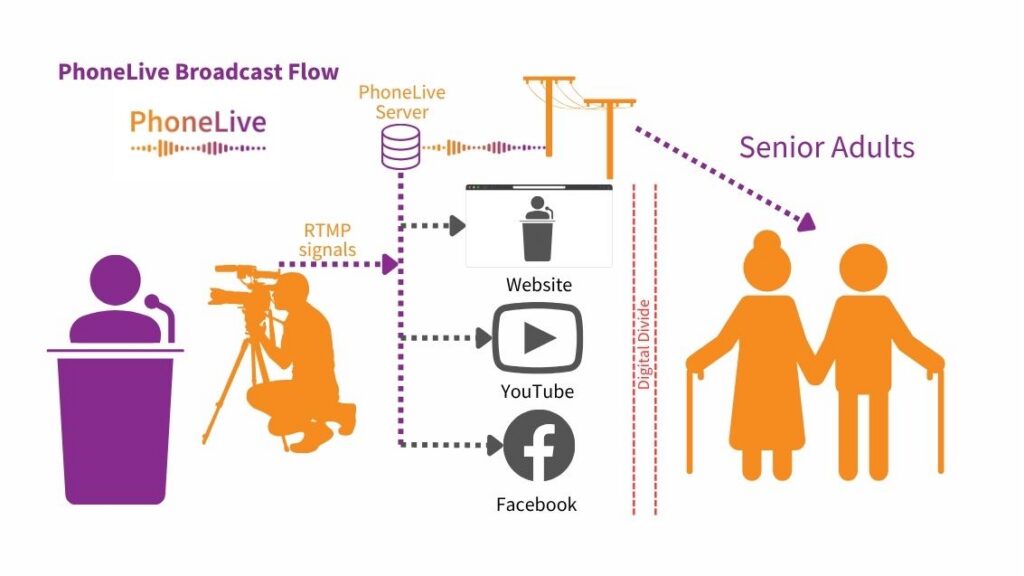
- Obtain RTMP Credentials: The telephone broadcasting service will provide an RTMP URL and a unique Stream Key.
- Configure the Encoder: In the church’s live streaming software or hardware encoder, add a new custom RTMP destination using the provided URL and Stream Key.
- Simulcast: When the church begins its live stream, the encoder will simultaneously send the video/audio feed to platforms like YouTube and the audio-only feed to the telephone service.
- Broadcast: The telephone service automatically processes the audio and makes it available to callers on the dedicated phone line.
This method requires no additional hardware and ensures that the telephone listeners hear the same high-quality audio mix as the online video viewers.
Method 2: Direct Audio Interface Connection
For churches using conference call services or those without an RTMP-capable streaming setup, audio must be routed directly from the soundboard to a device connected to the phone line.
- The Audio Interface: Connect the Aux mix output to a USB audio interface (e.g., Focusrite Scarlett or Behringer U-Phoria).
- The Connection Device: Connect the audio interface to a computer or a smartphone.
- The Broadcast: Use the computer or smartphone to dial into the conference call bridge. Select the audio interface as the microphone input in the conferencing software (e.g., Zoom or the FreeConferenceCall desktop app).
What Pastors Say About the Impact of PhoneLive.io on Shut-Ins
“Faithful saints can still enjoy church. One listener in assisted living has her friends join her every Sunday. Others who cannot drive still can make it to church. Our audience is growing, and Gospel is not being hindered.”
Marty Swinehart, Grace Cathedral
“Our seniors, especially, are grateful for being included in worship and Bible study.”
Steve Perky, The Saint Paul’s Baptist Church
“It works. Never had a problem. Elderly listen to it and love it.”
James Bevelle, Galilee Missionary Baptist Church Norwood
Best Practices From Over 1,200 Churches That Serve Homebound Members
Implementing the technology is only the first step. To truly serve bedridden and elderly members, churches must communicate effectively and adapt their services to include remote listeners.
Effective Communication
The success of a telephone alternative relies entirely on the congregation knowing it exists and understanding how to use it.
- Direct Outreach: Do not rely solely on email or social media to announce the service, as the target demographic may not use these platforms. Pastoral staff or volunteers should make personal phone calls to bedridden and elderly members to explain the new service, provide the phone number, and walk them through the process.
- Printed Materials: Mail physical letters or postcards containing the dedicated phone number in large, easy-to-read print. Include instructions on how to call in or how to sign up for automated outbound calls.
- Regular Reminders: Continuously announce the telephone option during regular church services, encouraging attending members to share the information with friends or relatives who are unable to attend.
Adapting the Worship Experience
When a portion of the congregation is listening via telephone, they lack the visual context of the service. Worship leaders and pastors should be mindful of this “audio-only” audience.
- Verbal Context: If the leader introduces a visual element such as a video presentation, a physical prop, or a silent moment of reflection, they should provide a brief verbal explanation so remote listeners understand what is happening.
- Warm Greetings: Pastors should explicitly welcome those listening on the phone at the beginning of the service. A simple acknowledgment, such as “We welcome those joining us online and those listening in on the phone today,” fosters a sense of inclusion.
- Consistent Scheduling: Start the live stream precisely on time. If you delay the service, remote listeners may assume the system is broken and hang up. Consider playing a prelude or a welcome message before the official start time, so callers know they have connected successfully.
Conclusion
Ministries can now offer a church live stream via a simple, powerful, and inclusive phone call to bridge the digital divide for bedridden, elderly, and isolated members. By choosing a professional, dependable platform and implementing thoughtful communication strategies, churches can empower the entire congregation to remain connected, engaged, and spiritually nourished, regardless of their physical location or technological capabilities.
Learn how PhoneLive.io has broadcast over 85 million minutes of the Gospel across North America when you schedule a demo at PhoneLive.io.
Frequently Asked Questions About Church Live Streaming via Telephone
Any system that uses the RTMP protocol is compatible with PhoneLive.io, including Resi, Boxcast, Switchboard Live, Restream, StreamYard, vMix, Wirecast, OneStream, and more.
There is nothing for the church or listener to install. PhoneLive.io is hosted entirely in the cloud.
PhoneLive.io has a minimum monthly subscription for churches and charges per minute used. Minutes are the sum of your broadcast minutes and the number of minutes listeners tune in. For example, if you broadcast for 30 minutes and one listener tunes in for 15 minutes while another listens for 10 minutes, you will be billed for 55 minutes total.
No. All subscribers receive access to all features regardless of their subscription tier.
PhoneLive.io works with other streaming services as a one-way broadcast, the last broadcast remains available for listeners who call in later, and it provides detailed reports showing who listened, when, and for how long.
PhoneLive.io only provides toll-free phone numbers to its customers, so listeners never receive a long-distance phone bill regardless of whether they have a long-distance plan. This protects elderly members from unexpected charges that services like FreeConferenceCall.com may incur.
Sound quality is reasonable and is impacted by the phone lines, the listener’s phone, and the signal transmitted. Mono signals perform better than stereo over the phone. Deep bass and loud sounds can occasionally be clipped by the phone line.
PhoneLive.io’s RTMP broadcast is 100% automated. You may need a staff member to review the weekly attendance reports and identify follow-up opportunities for pastoral care.
PhoneLive.io operates on a month-to-month contract. You may cancel at any time with no long-term commitment required.
PhoneLive.io’s developer is trusted by the White House and the Senate for the quality and security of their work. PhoneLive.io does not share your data with any third parties.
About the Author: Hugh Plappert
Hugh Plappert serves as the COO of PhoneLive.io, bringing over four decades of technical expertise to the mission of church. Before pivoting his focus to ministry technology, Hugh established himself as a premier professional database consultant for Fortune 500 and Inc 500 firms. His extensive background in managing complex data systems ensures that PhoneLive.io application impacts the ministry quality and reach of churches across North America.
Beyond his corporate success, Hugh’s true passion lies in serving the Kingdom and supporting local congregations. For over 40 years, he has spearheaded various church projects, from streamlining national ministry operations to providing decades of technical support for the Apostolic Bible Institute. Today, he combines his high-level technical discipline with a heart for senior adult ministry. His leadership ensures that every church member, regardless of their technical ability, can stay connected to the Word of God.